
Illnesses and Herbalism
From Grouse House Wiki
| Table of Contents |
|---|
| Links not working? Sections must be expanded to jump to a subheader within them! |
| Foraging |
| Herbs |
| Herbalists |
| Mixing Medicine |
| All Medicines |
| Illnesses |
| Getting Sick |
| Preventing Illness |
| Diagnosing Illness |
| Curing Illness |
| Contagious Illnesses |
| Lethal Illnesses |
| Illness List |
Illnesses are a persistent mechanic that add a level of unpredictability and challenge to the Wolvden experience! While playing casually, your wolves will be able to get sick and injured, and you will be able to assist them with the help of a Herbalist. Illnesses can catch you off-guard if you're not prepared to address them as they pop up, so understanding illnesses and herbalism can be very important to ensuring your pack's longevity.

Illnesses and herbalism are unlocked on your fourth rollover with a new unique quest, Sickness and Health. Upon rolling over, Tala will inform you that your lead wolf has fallen ill and will walk you through assigning a Herbalist and treating the illness. New players have a brief illness immunity: until you have completed the Sickness and Health quest and rolled over five times, your wolves will be incapable of developing illnesses and you will be unable to assign wolves the Herbalist and Forager roles.
Contents
- 1 Foraging
- 2 Foraging
- 3 Herbalists
- 4 Herbalists
- 5 Illnesses
- 6 Illnesses
Foraging
Foraging
In order to start making medicine and curing illness in your pack, you first need to collect Herbs. Herbs can be found frequently while Exploring. Primarily, however, they can be collected by a specialized wolf: a Forager!

You unlock the ability to assign a wolf the Forager role after completing the Sickness and Health unique quest. Your pack can have a maximum of three foragers, and there is no way to increase this number.
You can send your Foragers out to collect herbs from the Herbalist page and the Foraging tab.

Once there, you can select the Forager you would like to send as well as the biome you would like to send them to. It's implied that eventually foragers may be able to collect more than just herbs, hence the additional dropdown menu in which Herbs is currently the only option. You can forage in any biome you have fully scouted. However, the further the biome is away from your home biome, the longer the foraging mission will take. You can send all three of your foragers out at the same time, each to a different biome. Only wolves with the Forager role may be sent foraging—Herbalists may not.


By default, Foragers will bring back one or two herbs as a standard reward. With every 25 proficiency your Forager gains, they will bring back one additional herb, with 75 being the last threshold. So, a Forager with 75+ proficiency will bring back five herbs, the current max amount of herbs possible. However, in the winter, the max amount of herbs that your Forager may bring home will be lowered by one.
The amount of time that each forage takes is affected by the Forager's Speed stat. The Speed stat divided by ten determines how much time is removed from the forager, with 10 minutes being the maximum.
If your lead wolf has the talent "Gatherer", foraging time will be further reduced by 10%.

Herbs
Herbs
Herbs are used to craft medicines for your wolves. They are also used in crafting recipes for decors and backgrounds, and can be used to craft Nesting Materials as well! Foragers can bring home herbs from foraging. You can also find herbs randomly while exploring.
If you need a specific herb but don't have the biome unlocked to find it, you can exchange herbs on the Exchange Herbs tab from the Herbalist page. Trading in three of one herb you have will give you one of any herb of your choice.

Below is a table of every herb, including what they are used for and where you can find them. When a herb is listed as being in a certain biome, this means that it can both be foraged there as well as found there while exploring normally. There are a few explore encounters, such as the raven, which can give you herbs from any biome regardless of what their native biome is.
| Herb | Uses | Biomes |
|---|---|---|
 Aloe |
|
|
 Arnica |
|
|
 Bearberry |
|
|
 Boneset |
|
|
 Buffaloberry |
|
|
 Burning Bush |
|
|
 Carrionflower |
|
|
 Cedar Bark |
|
|
 Chaparral |
|
|
 Charcoal |
|
|
 Dandelion |
|
|
 Feverfew |
|
|
 Garlic |
|
|
 Ginger |
|
|
 Goldenseal |
|
|
 Guaiacum |
|
|
 Kava |
|
|
 Mullein |
|
|
 Oregano |
|
|
 Pineapple Leaf |
|
|
 Redwood Sorrel |
|
|
 Spoonwood |
|
|
 St. John's Wort |
|
|
 Tansy |
|
|
 Tobacco |
|
|
 Turmeric |
|
|
 Winterfat |
|
|
 Yarrow |
|
|
Herbs Not Used in Herbalism
The following herbs can only be obtained through foraging and exploring during the month of November as a part of the Coigreach event. They can be used to exchange for other herbs on the herbalist page, but cannot be exchanged for themselves. They currently have no use besides crafting nesting material.
 Elder |
 Elfwort |
 English Marigold |
 Evening Primrose |
 Meadowsweet |
 Nettle Leaves |
 Vervain |
 White Clover |
 Woad |
 Wood Betony |
Herbalists
Herbalists
Herbalist is a role that you can assign to a pack wolf. The herbalist can complete a variety of tasks related to herbs, medicine, and illnesses, alongside the friendly herbalist bear, Herbert.

| Herbert | ||
 |
You approach the silver-dusted old grizzly bear, sitting deep in thought under his gnarled tree, which serves as a gatherplace to talk to all animals - both living and those passing between worlds.
|
|
Bear |
He/Him |
|
    | ||
You can have one herbalist total and you are stuck with just one, there is no way to increase the amount of herbalists you can have. When you switch the herbalist role from one wolf to another, whether that be because the previous herbalist died or just because you want a new one, your wolves will forget up to three medicine recipes. The recipes for Cure-for-All and Rich Healing Salve are not protected and may be forgotten as well as regular medicines. You will have to relearn these recipes normally with your new herbalist. It does not tell you when you switch herbalists that recipes have been lost. You have to check your user log to see which ones were forgotten. Restoring the same herbalist to the position will not restore the recipes.
Mixing Medicine
Mixing Medicine
Herbalists gain experience by mixing medicines. Mixing medicines is an important step in curing any illnesses that your wolves contract. The first time a herbalist crafts a medicine, they must use collected herbs to research it. This can be done from the Research Medicine tab. The researching will result in a one-use version of the cure, and will add the cure to your Medicines Known tab. The ingredients used to learn to create a cure are the same ingredients that are used to create them each subsequent time.
Medicines crafted from the Medicines Known tab (with the exception of the Cure-for-All) will have full potency, two uses instead of one. At 80% proficiency or higher, any Medicine: Healing Salve or Medicine: Rich Healing Salve that your herbalist crafts will be three uses instead of two. This applies only to the Healing Salves and no other medicine.

The time it takes to craft/research a medicine is dependent on the herbalist's level, and each medicine takes 20% energy. The higher the level, the shorter the crafting/research time. You can have up to five medicines queued for crafting/researching at a time, assuming your herbalist started with 100% energy.
If your lead wolf has the talent "Physician", the amount of time it takes to craft known medicines is further reduced by 10%. This does not apply to medicines which are being newly researched.
Once a herbalist has researched all 19 medicines, one for each illness as well as the Healing Salve, you will unlock two additional craftable medicines, the Rich Healing Salve and Cure-for-All.
| Medicine | Use | Recipe |
|---|---|---|
 Rich Healing Salve |
Restores 50 HP and gives illness immunity for three rollovers. | Aloe (1) Buffaloberry (1) Burning Bush (1) Chaparral (1) Charcoal (1) |
 Cure-for-All |
Cures any illness and gives illness immunity for three rollovers. | Aloe (1) Arnica (1) Boneset (1) Carrionflower (1) Cedar Bark (1) Ginger (1) Mullein (1) Spoonwood (1) Tansy (1) Turmeric (1) |
All Medicines
All Medicines
There are 21 total medicines that your herbalist is able to mix. Most of these medicines cure one specific medicine. However, Cure-for-Alls can cure any illnesses, and healing salves restore HP instead of cure illnesses.
| Medicine | Use | Recipe |
|---|---|---|
 Antidote |
Cures Poison |
Chaparral (3) |
|
|
Cures Constipation |
Bearberry (1) |
|
|
Cures Cough |
Goldenseal (1) |
Cure-for-All |
Cures any illness and gives illness immunity for three rollovers. | Aloe (1) Arnica (1) Boneset (1) Carrionflower (1) Cedar Bark (1) Ginger (1) Mullein (1) Spoonwood (1) Tansy (1) Turmeric (1) |
|
|
Cures Cystitis |
Dandelion (1) |
|
|
Cures Diarrhea |
Charcoal (3) |
|
|
Cures Distemper |
Goldenseal (1) |
|
|
Cures Ear Mites |
Carrionflower (1) |
|
|
Cures Fleas |
Tobacco (3) |
|
|
Restores 20 HP |
Charcoal (1) |
|
|
Cures Heatstroke |
Feverfew (1) |
|
|
Cures Hepatitis |
Boneset (1) |
|
|
Cures Infection |
Feverfew (1) |
|
|
Cures Influenza |
Guaiacum (2) |
|
|
Cures Mange |
Arnica (1) |
|
|
Cures Open Wound |
St. John's Owrt (1) |
|
|
Cures Pox |
Oregano (1) |
Rich Healing Salve |
Restores 50 HP and gives illness immunity for three rollovers. | Aloe (1) Buffaloberry (1) Burning Bush (1) Chaparral (1) Charcoal (1) |
|
|
Cures Ringworm |
Aloe (1) |
|
|
Cures Tapeworm |
Bearberry (1) |
|
|
Cures Ticks |
Cedar Bark (1) |


Illnesses
Illnesses
There are currently 18 possible illnesses, each with their own set of effects. Based on these effects, some illnesses are much more severe than others. When a wolf develops an illness, a banner will appear on their page listing symptoms, to give you an idea of what the wolf might have before diagnosis. For some illnesses, like Tapeworms, this notice can also provide insight on the illness's effects. All illnesses also double mood loss at rollover, meaning any sick wolf will lose 10% mood instead of 5% mood every day.

Wolves can only have one illness at a time, and every wolf regardless of age is capable of contracting them. While some illnesses have a small chance of going away on rollover, most illnesses will remain until the wolf is cured.
Getting Sick
Getting Sick
Wolves can get sick through a variety of means, many unpredictable. Every wolf in your pack has the ability to develop an illness, even pups, so it's important to keep an eye on your pack to make sure that everyone is healthy!
When a wolf develops an illness, an icon will be added next to their information on your Den page letting you know that they are unwell.  They will also appear in the Action Required section of the home page, where you can quickly view which wolves need attention.
New players have a short period of immunity from illnesses while they are learning about the game. For your first five rollovers, your wolves will be incapable of developing illnesses. New players, however, can purchase or accept ill wolves into their pack, while still being unable to diagnose their illness or craft medicine. In order to prevent accidentally locking yourself into not being able to treat an ill wolf, be sure to avoid purchasing any ill wolves until after you complete the Sickness and Health quest.
Spontaneous Illnesses
Some illnesses will occur randomly throughout casual gameplay. When a wolf develops an illness, it will be noted by the game, sometimes alongside an illness icon, so reading through every log and message you get can be helpful in catching any illnesses that fly under your radar.
Developing an Illness on Rollover
Wolves of any age can randomly develop a small variety of illnesses upon rolling over. If a wolf is immune to illness due to a medication, they will be prevented from contracting an illness on rollover. When a wolf spontaneously develops an illness, notice of this will be provided in your daily rollover summary.
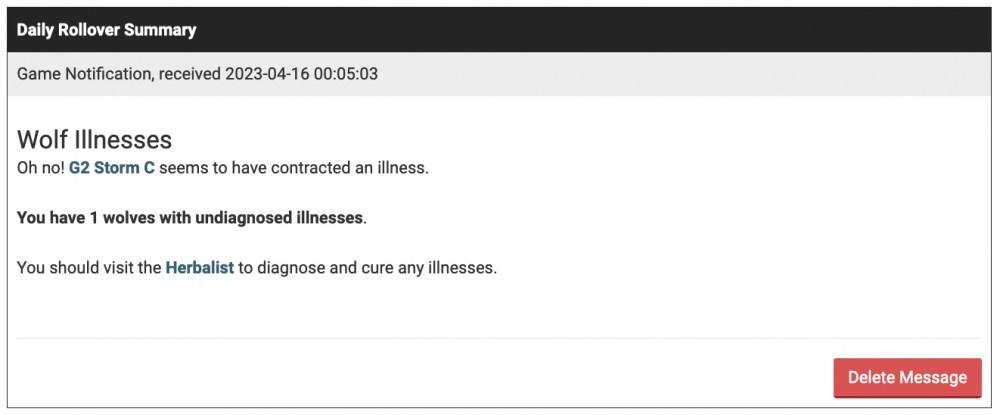
All of the illnesses that wolves can get randomly on rollover are listed below.
- Cough
- Cystitis
- Distemper
- Heatstroke
- Influenza
- Pox
Exploring and Battling
Lead wolves can develop illnesses from exploring and battling. When a lead wolf gets an illness, you'll find a notice about it in the explore text box alongside an illness icon.
The interacting with certain encounters can give your lead wolf a specific illness. If your lead wolf is already sick or immune, these encounters will only result in HP loss.
- Constipation (joining the berry bear in foraging, chomping on the migrating monarch butterflies)
- Cough (enjoying the view of the glacier aurora)
- Diarrhea (rolling in poop, snatching the American robin)
- Fleas (racing with the Dall sheep)
- Infection (taking a chance or swimming in the floodwater)
- Influenza (chasing the gulls around the dead muskox, joining the playing ravens)
- Open Wound (running in the desert snow, stealing from the hunting crocodile, getting closer to the sperm whale, using the opportunity on fighting stags)
- Poison (getting a closer look at the black widow, licking the Rocky Mountain toad, pouncing on the Mojave tarantula)
- Ticks (attacking the Yucatan brown brocket)
Lead wolves can also get the following illnesses after losing a battle.
- Ear Mites
- Fleas
- Infection
- Influenza
- Mange
- Open Wound
- Poison
- Ticks
Completing Tasks
Pack wolves can develop illnesses and injuries from completing their role's tasks.
Illnesses that pack wolves can develop spontaneously after completing a hunt or scouting mission are listed below.
- Ear Mites
- Fleas
- Infection
- Influenza
- Mange
- Open Wound
- Ticks
Befriended Wolves
Wolves you have befriended while exploring may join your pack with a random illness of the few listed below.
- Influenza
- Open Wound
- Ringworm
Rotting Food
Food items don't last forever, as nice as that would be! Any carcass or other food item that you get from hunting, exploring, or otherwise, will rot eight rollovers after you get it. On the last day of rotting, the food item will become dangerous to feed to your wolves.

When a food item has a red background in your Hoard, it has the chance of giving your wolf an illness when fed. This chance is per the number of times a wolf is fed, not per uses fed. So, if a wolf is fed a rotting food item with 10 uses, they have a lower chance of becoming sick than from consuming 10 rotting items with one use. Rotting food will not be fed to wolves if you use Feed All Play All.
The illnesses possible from feeding a wolf a rotting carcass are listed below.
- Constipation
- Diarrhea
- Ear Mites
- Fleas
- Tapeworms
Illnesses from Breeding
Wolves can develop illnesses after breeding, both within a pair bond and with a breeding male. If one of the wolves being bred has a contagious illness, there is a chance for the illness to be spread to the second wolf. In addition to this, a few illnesses can appear spontaneously in the breeding of two healthy wolves.
Below are the illnesses that can pop up randomly after a breeding of two healthy wolves.
- Cystitis
- Hepatitis
- Pox
Preventing Illness
Preventing Illness
There are a few approaches to preventing illnesses that you could consider if you are worried about your pack being taken off-guard by a plague.
When you give a sick wolf the medicine to cure their illness, the wolf will be given a one rollover period of immunity from any illness. If the medicine given was a Cure-for-All, the immunity will be extended to three rollovers. If you find that your wolves are extra susceptible to illness, you may choose to cure them each time with a Cure-for-All, to lessen the number of days that they are capable of catching an illness.

Some players choose a harsher method of preventing severe illnesses—illness farming. Giving every wolf in your pack a mild illness like Fleas will prevent them from developing a more severe or lethal illness like Distemper. This also gives you the opportunity to farm experience for your herbalist by diagnosing and curing the illness, only for the wolf to catch it again the next day from one of the many other wolves who still have it. There are some downsides to this method, like greater mood loss, but many players find it effective in fending off severe outbreaks.
Diagnosing and Curing Illness
Diagnosing and Curollove.rring Illness
In order to cure a wolf's illness, you must use a specific medicine designated for that ailment. Medicines typically have the illness's name in their name. For example, Open Wound Salve will cure Open Wound and it cannot be used for any other illnesses. The only exception to this is Antidote, which cures Poison.
Before curing an illness, the wolf must be diagnosed at the herbalist. Diagnosis is required before you are able to cure an illness, but having a herbalist is not required to do it. If you do not have a herbalist, Herbert will help you diagnose your wolf's illness instead.
Diagnosing an illness can be done from the Sick Wolves tab of the Herbalist page, and requires  Silver Cones to complete. The amount of SC required to diagnose a wolf's illness is tied to your herbalist's proficiency, with higher proficiency correlating to cheaper diagnosis costs. At 80 proficiency, your herbalist is able to diagnose illnesses for free. After a wolf has been diagnosed, you can cure them from the same place you diagnosed them if you have a cure on hand.
| Proficiency | Cost |
|---|---|
| 0% – 3% | 20 SC |
| 4% – 7% | 19 SC |
| 8% – 11% | 18 SC |
| 12% – 15% | 17 SC |
| 16% – 19% | 16 SC |
| 20% – 23% | 15 SC |
| 24% – 27% | 14 SC |
| 28% – 31% | 13 SC |
| 32% – 35% | 12 SC |
| 36% – 39% | 11 SC |
| 40% – 43% | 10 SC |
| 44% – 47% | 9 SC |
| 48% – 51% | 8 SC |
| 52% – 55% | 7 SC |
| 56% – 59% | 6 SC |
| 60% – 63% | 5 SC |
| 64% – 67% | 4 SC |
| 68% – 71% | 3 SC |
| 72% – 75% | 2 SC |
| 76% – 79% | 1 SC |
| 80% – 100% | Free |
After diagnosing the wolf at the herbalist, you can give them the cure from the Sick Wolves page or your Hoard. This will cure their illness and provide one rollover of illness immunity to the wolf. This means that the wolf will be unable to contract any more illnesses until you rollover one time.
There are some illnesses—Constipation, Cough, Cystitis, and Diarrhea—which have a small chance to cure themselves on rollover. If this occurs, you will see a note in your Daily Rollover Summary informing you that the wolf is feeling better. Besides with these illnesses, wolves will stay sick until you cure them.
Contagious Illnesses
Contagious Illnesses
Contagious illnesses are illnesses which can spread to other wolves on rollover. Each contagious illness has a percentage chance out of 100 that the illness will be spread to one other wolf, with some illnesses being much more contagious than others.
Upon rollover, one illness can only spread to one other wolf at a time. For example, if you have two ill wolves, a maximum of two healthy wolves might contract the contagious illness on rollover. If you have six ill wolves, six healthy wolves could catch the illness. With this in mind, contagious illnesses can spread very quickly and exponentially, so it's important to cure them as quickly as you can or isolate the ill wolves from others in your pack. When an illness is spread between wolves, notice of this will be included in your daily rollover summary.

Contagious illnesses, for the most part, are contained with caves. An ill wolf in one cave cannot pass their illness to a healthy wolf in another cave. Isolating a wolf with a contagious illness in their own cave will prevent the illness from being spread. However, lead wolves and unsorted wolves, since they are not in caves, are exempt from this and can spread illnesses to wolves in any caves.
If a wolf has an illness immunity from a previously given medicine, they will not be able to contract a contagious illness. This immunity alongside cave isolation are the only ways to prevent contagious illnesses from spreading.
Lethal Illnesses
Lethal Illnesses
Lethal illnesses are very severe illnesses that can kill a wolf. Lethal illnesses, with the exception of Pox in puppies, will only kill a wolf if the wolf has zero HP going into rollover. If a wolf has a lethal illness, but more than zero HP going into rollover, they will not die from the illness. If they go into the rollover with one or two HP and drop to zero HP during the rollover, the illness will not kill them either.

An exception to the zero HP rule is Pox. If a puppy (under the age of six months) contracts Pox, they will die the next rollover regardless of what their HP was at. Pox is not lethal to wolves six months and older.
Lead wolves and breeding males are immune to lethal illness and cannot be killed by illnesses. The only way to remove a lead wolf or breeding male early is to spend Gold Cones to retire them manually.
Illness List
Illness List
The table below details every illness and its associated effects. You can also view a similar table in image form here.
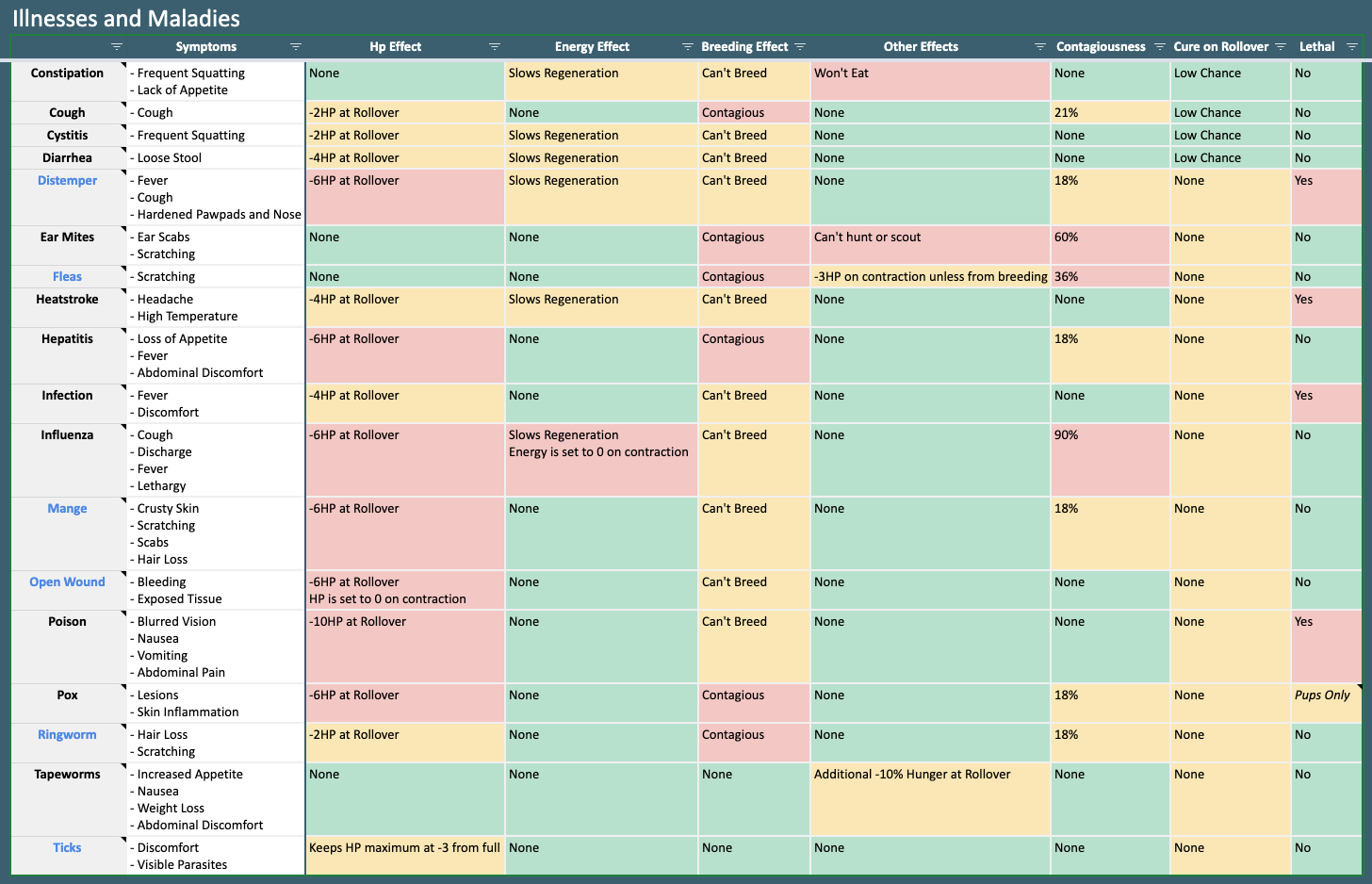
The HP effect column indicates how much HP is lost every rollover due to this illness. The energy effect and breeding effect indicates the effects the illness has on energy regeneration and breeding respectively. Contagiousness details the percent chance of the illness passing to one other wolf on rollover. Other Effects might include lethality, an illness's special effects, chance to cure on rollover, etc. Like noted at the top of the table, all illnesses cause double mood loss at rollover.
| Illness | HP Effect | Energy Effect | Breeding Effect | Contagiousness | Other Effects |
|---|---|---|---|---|---|
| Note: ALL illnesses cause double mood loss at rollover (5% becomes 10%) | |||||
| Constipation | None | Slows Regeneration | Can't Breed | Not Contagious | Won't eat, Low chance to cure on rollover |
| Cough | −2 HP | None | Contagious | 21% | Low chance to cure on rollover |
| Cystitis | −2 HP | Slows Regeneration | Can't Breed | Not Contagious | Low chance to cure on rollover |
| Diarrhea | −4 HP | Slows Regeneration | Can't Breed | Not Contagious | Low chance to cure on rollover |
| Distemper | −6 HP | Slows Regeneration | Can't Breed | 18% | Lethal |
| Ear Mites | None | None | Contagious | 60% | Can't hunt or scout |
| Fleas | None | None | Contagious | 36% | −3 HP on contraction unless from breeding |
| Heatstroke | −4 HP | Slows Regeneration | Can't Breed | Not Contagious | Lethal |
| Hepatitis | −6 HP | None | Contagious | 18% | None |
| Infection | −4 HP | None | Can't Breed | Not Contagious | Lethal |
| Influenza | −6 HP | Slows Regeneration | Can't Breed | 90% | Energy set to zero on contraction |
| Mange | −6 HP | None | Can't Breed | 18% | None |
| Open Wound | −6 HP | None | Can't Breed | Not Contagious | HP set to zero on contraction |
| Poison | −10 HP | None | Can't Breed | Not Contagious | Lethal |
| Pox | −6 HP | None | Contagious | 18% | Lethal to pups after one rollover |
| Ringworm | −2 HP | None | Contagious | 18% | None |
| Tapeworms | None | None | None | Not Contagious | Additional -10% hunger at rollover |
| Ticks | Keeps HP max at −3 from full | None | None | Not Contagious | None |